
Timeline (Key Facts)
- 1907: He was born.
- 1930: He was appointed as Hindi teacher in Shanti Niketan.
- 1950: End of office in Shanti Niketan and became head of the Hindi department at BHU.
- 1960: End of his office at BHU and joined Punjab University, Chandigarh.
- 1957: He was awarded the Padma Vibhushan.
- 1973: Won the Sahitya Akademi Award.
- 1979: He died on 19 May.
Biography of Acharya Hazari Prasad Dwivedi
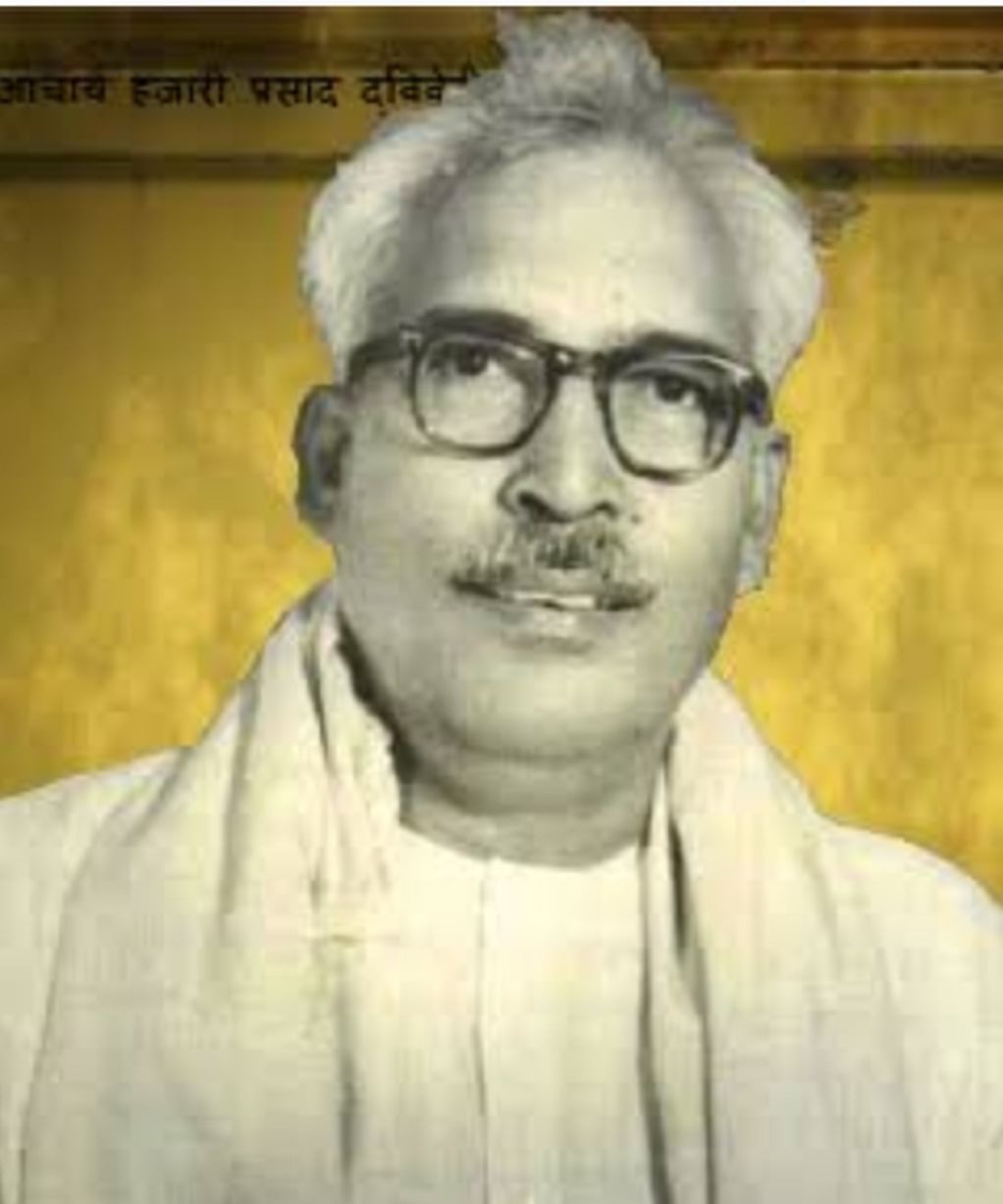
Acharya Hazari Prasad Dwivedi was born on 19 August 1907 in a village (Dubey-ka-Chhapra) in the Ballia district of Uttar Pradesh and died on 19 May 1979. His father Anmol Dwivedi was a Sanskrit scholar. He had his initial education in his village school.
To pass his master's degree in astrology as well as the degree of Shastri in Sanskrit, he had to study in the traditional school of astrology and Sanskrit. He wrote a number of essays on various kinds of novels, medieval spiritual movements of India, especially historical researches on the Kabir and Nath sect.
Acharya Hazari Prasad Dwivedi is a great Hindi novelist, famous literary historian, mythological essayist, researcher, outstanding writer, scholar, critic of modern period as well as a master in many other languages apart from Hindi (eg Sanskrit, Gujarati, Pali, Bengali, Punjabi, Apabhramsa and prakrit).
He played a major role in the development of Sahitya Shastra and is regarded as a noted critic of the textual tradition of Indian writing. He was intended as the creator of a huge bridge between the past and the present. He was heavily influenced by Namwar Singh, Shiv Prasad Singh and Vishwanath Tripathi. And those who influenced him were Kabir and Rabindranath Tagore.
He got his passion for astrology and his love for Sanskrit.
He received his primary education in Sanskrit language. He completed his intermediate degree and passed the examination of Acharya in Astrology from Banaras Hindu University in 1930. From 1940 to 1950 he held the office of Hindi director of Visva-Bharati Bhavan. His close connections with Rabindranath Tagore, Kshitimohan Sen, Vidushekhar Bhattacharya and Banarasidas Chaturvedi served as an impetus for his literary activity.
He was the most prominent personality and important literary figure of Hindi literature after Acharya Shukla period. He made his untiring efforts to analyze Hindi literature in many languages such as Sanskrit, Pali, Prakrit etc. He was a man of encyclopedic mind and his ability to write and read was exceptional. All their great collections are based on religion, philosophy, linguistics, history and general science. He composed many articles, thesis, magazines, reports and memorabilia on various subjects.
He has written many books on Hinduism, Tantric, Jain, Gandhian studies, Marxism, Shaivism, Vaishnavism, Buddhism and Sikhism. His great collection of writing work is known as Hazari Prasad Dwivedi Collection (or HDP Collection), which is housed in IGNCA (Indira Gandhi National Center for the Arts, New Delhi) for research purposes for research students is available. His collection which has been kept safe at IGNCA was donated by his children to the Indira Gandhi National Center for the Arts.
The business
He started his career on 18 November 1930 as a Hindi professor in Shanti Niketan. He was promoted as director in the office of Visva-Bharati Bhavan in 1940. During his working life, he met Rabindranath Tagore in Shanti Niketan. He left Shanti Niketan in 1950 and joined the Banaras Hindu University as the head and teacher of the Hindi department. Meanwhile, he was also elected as a member of the first Official Language Commission set up by the Government of India in 1955. After some time, in 1960 he joined Punjab University, Chandigarh. He was selected as the Head and Professor of the Hindi Department at the Punjab University.
Hazari Prasad Dwivedi's compositions (books)
- Material science
- Element metaphysics
- Character art
- News editing
- News editing and writing
- Research method
- Mrityunjay Ravindra
- Memory of great men
- Kambharamayan
- Kritivasaramayan
- Brief earth
- Sandesh Rasak
- Methods of research and survey
- Rise of scientific philosophy
- Maithili Shriramcharitra-Mansa
- Plato's Republic
- Vedanta Doctrine
- Brahmasutra language
- Ram Katha
- Kashmiri ram avatar character
- Hazari Prasad Dwivedi Bibliography
- Meghdoot: an old story
- Artistic humor of ancient India
- Simple practice
- Sandesh Rasak
- Remembrance of Sikh Gurus
- Sur literature
- Thought flow
- Create Nath Siddhas
- Mantra tantra
- Meghdoot is an old story
- Did Rajni's day go on forever
- History of freedom struggle
- Language literature and country
- Indian tradition and viewers of dance literature
- Vast historical grammar of Hindi language
Stories by Hazari Prasad Dwivedi
- Mango got mad again
- Shirish flowers
- Fiction of Lord Mahakal
- After the great epic of the Mahatma
- Thakur ji's vatoor
- Confluence of cultures
- Critic's mail
- Stories written by women
- Ketu Darshan
- Universe expansion
- Wow gone
- What can literary institutions do
- What do we do
- The Greatest Masterpiece: Literature
- Internal assurance is also necessary
- Biggest solution to problems
- New step of literature
- Historical significance of Adikal's inter-provincial literature
Other great work
He has great contributions in creative and critical literary writings. Some of his important works are the role of literature and the beginning of Hindi literature. Both these compositions have given a new way and way to the history of Hindi criticism. Following are some works related to historical analysis of medieval spiritual life of India:
- Kabir
- Destruction community
- Medieval Religion
- Role of hindi literature
- Renegade
- Charuchandra article
- Anamdas's story
Following are some of his great and excellent essays:
- Ashoka flowers
- Kutz
- Why do nails grow
- Thought flow
- Fantasy
- Ideas and arguments
- Luster festival
Some of his Hindi translations are:
- Antiquity collection
- Management anxiety
- Red canner
- World introduction
Some works on his history are as follows:
- Literature
- Literature communication
- Kalidas's elegance scheme
- Hindi Literature: Origin and Development
- Timeline of Hindi literature
- Thoughts on modern Hindi literature
- Heart of literature
- Elegance epistemology
- Medieval Buddhist Form
Awards and achievements
- Acharya Hazari Prasad Dwivedi was awarded the Padma Bhushan in 1957 for his great literary contribution to the field of Hindi.
- He was awarded the Sahitya Akademi Award in 1973 for a set of essays known as Alok Parva.
- He was conferred with the post of Professor by Punjab University, Chandigarh as well as the President of the Hindi Department.
- He also worked at Banaras Hindu University as a rector.
- He headed UP at the Hindi Academy Lucknow.
Thanks
*****************

My name is Sajeel Ahmad I am a Software Developer, Blogger, Entrepreneur, Digital marketer, Technology, and many more...After completion of my studies in Bhopal, I move to Delhi for my first job. I started working in TCS as a software I am fascinated my page viewer in all languages to read the blog easilyengineer.
Please do not enter any spam link in the comment box. ConversionConversion EmoticonEmoticon